Category: #1 Opening Image

Beat #1: Opening Image. (0-1)%
This is the first beat of Act 1 and it serves as a “before” snapshot of your main character (who from here on out I will refer to as the “hero” of your story), where you visually show, in a single scene, who your hero is and what their world or life is like.

  • Quote Pauline Reáge


    Quote from Good Girl

    “Keep me rather in this cage, and feed me sparingly, if you dare. Anything that brings me closer to illness and the edge of death makes me more faithful. It is only when you make me suffer that I feel safe and secure. You should never have agreed to be a god for me if you were afraid to assume the duties of a god, and we know that they are not as tender as all that. You have already seen me cry. Now you must learn to relish my tears.”
    Pauline Reáge
    Story of O


    Quote from Bad Girl

    Her surrender was not the surrender of one who has lost, but the surrender of one who has finally found herself.
    Pauline Reáge
    Story of O


    Quote in Ugly Girl

    There is nothing uglier than a woman who gives herself without desire
    Pauline Reáge
    Story of O


    Why this Quote?

    The novel Histoire d’O by Pauline Réage (published in 1954) does not contain many direct references to “ugliness” in the conventional sense—its tone is more focused on beauty, eroticism, submission, and power dynamics. However, there is a notable passage where ugliness is contrasted with the idea of submission or desire, often in a philosophical or symbolic way.
    A frequently cited line related to ugliness is:

    “Il n’y a rien de plus laid qu’une femme qui se donne sans désir.”
    “There is nothing uglier than a woman who gives herself without desire.”

    This quote reflects the novel’s recurring theme: that the erotic becomes disturbing or “ugly” when it lacks authenticity or voluntary surrender.

  • Hook

    A hook in a book is the part of the story that grabs your attention and makes you want to keep reading. Think of it like fishing — the hook is what catches the fish. In storytelling, the hook is what catches the reader. It can be a gripping first sentence, an intriguing event, a mysterious question, or a character facing a big problem right from the start.

    For example, if a book begins with, “I never thought I’d be running from the police at midnight,” that’s a hook. It makes you curious about why the person is running, what they did, and what will happen next. Hooks can appear at the beginning of a chapter, but they can also pop up anywhere in a book to keep the reader’s interest alive.

    A strong hook makes you want to turn the page. It can be a shocking twist, a secret revealed, or an exciting action scene. Without a good hook, a story might feel slow or boring. Writers use hooks to ensure readers don’t put their book down.

    In short, a hook is a way to keep the reader engaged and eager to know what happens next.

    Hook in Ugly Girl

    Kill Your Darlings

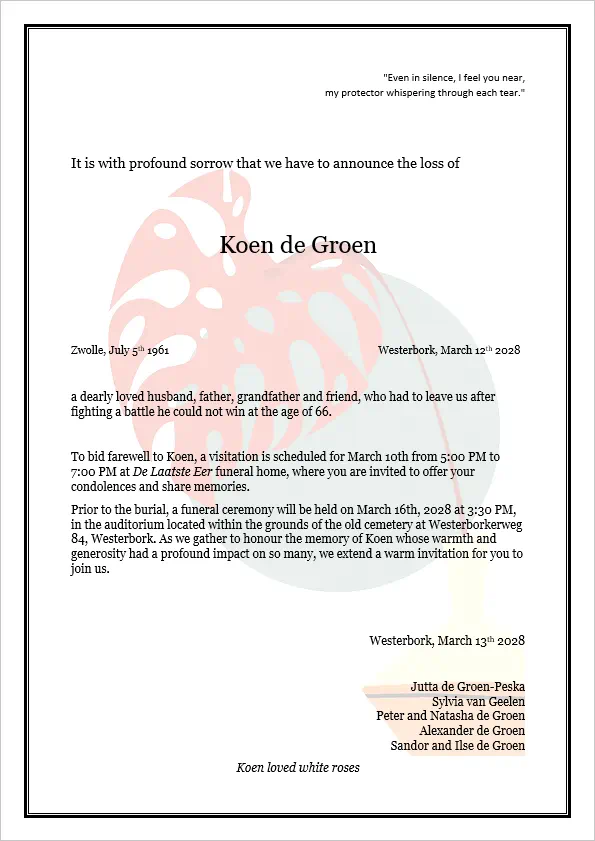
    Great writing advice: kill your darlings. Well, maybe meant in a different way, but this was quite radical. The Dutch Master is dead. 

    Writing fault #1: 

    The date I started the first book in Aeon Timeline. That means all the dates are now in 2027 and 2028. If I had to change it all, it would have cost me a full day. Besides, it’s boring.

    It’s still A bit awkward when you are writing in 2025. But nothing time won’t heal.

    (The plant is named Monstera. The picture is of Bianca van Dijk and is free for use on Pixabay.)